How the Upcoming MCP Auth Spec Tightens Up (PKCE Won't Save You)

What’s changing in the 2026-07-28 MCP authorization spec release and what you should do
TL;DR: The next version of the MCP authorization spec brings six changes: all hardening and interoperability fixes, no redesigns. If you build MCP clients: validate iss, store credentials per issuer, declare your application_type, and combine your scopes on step-up.
The Model Context Protocol (MCP) has become the standard way for AI applications to connect to external tools and data. It lets an AI assistant plug into your backend, your company’s systems, or a coding tool. But every one of those connections raises the same question: how does the tool know the AI is allowed in, and acting on behalf of the right person?
That’s the job of MCP authorization, a specification built on OAuth 2.1, the same framework that handles countless enterprise logins. The current spec version, 2025-11-25, laid down a solid foundation. The upcoming version, 2026-07-28, refines it. The release candidate is available, with final publication targeted for July 28th.
None of the six changes redesigns anything. They are hardening and interoperability fixes, and they all trace back to a single structural fact about MCP that’s worth understanding first.
The Problem Underneath All Six Changes
In a traditional app, the relationships are known in advance. Your banking app talks to your bank’s servers, which trust your bank’s login system. Everything was laid on the table ahead of time.
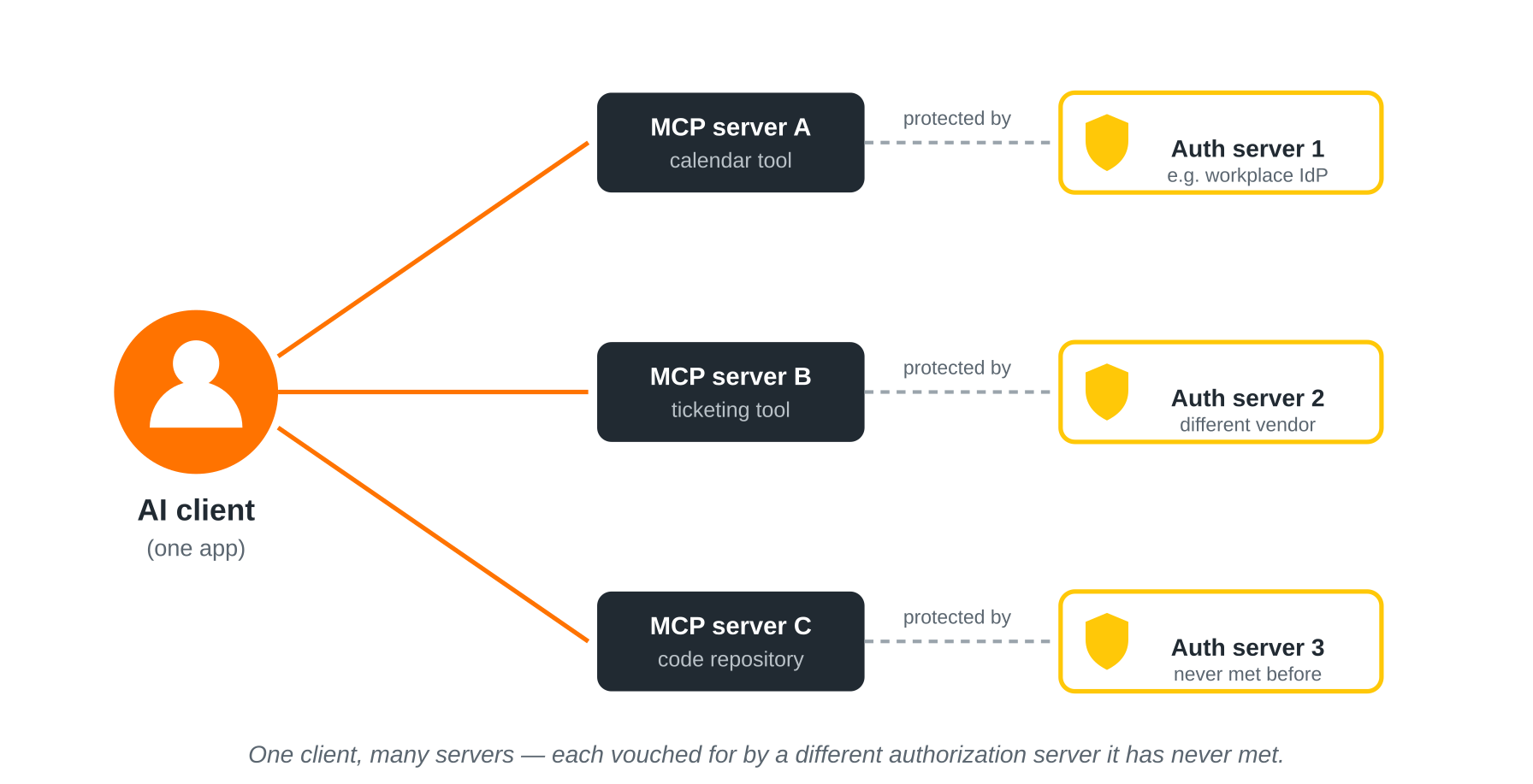
MCP breaks that assumption. An MCP client might connect to dozens of MCP servers built by different people. Each of them is protected by a different authorization server the client has never encountered before. It could be an enterprise identity provider like WSO2 Identity Server, a SaaS provider like WSO2 Identity Platform, or a custom OAuth server they built themselves.
The client connects to MCP servers, discovers which server authorizes them, registers itself, and obtains credentials - all happening dynamically.
This “one client, many unknown authorities” dynamic is powerful, but it stretches OAuth in ways typical deployments never do. Each of the six changes in this release candidate patches a specific place where that stretch showed.
1. Verifying the Issuer
The change: Clients must validate the iss (issuer) parameter on authorization responses, as defined in RFC 9207.
When you knock on a door and someone answers, you’d like to confirm they actually live there. Because an MCP client deals with many authorization servers, a malicious one could trick the client into handing over a login code meant for an honest server. This is known as a mix-up attack.
To avoid this, before starting the login flow, the client notes exactly which authorization server it intends to talk to. When the response comes back carrying an iss label, the client checks that the label matches its note. If it doesn’t, the client rejects the response and the login fails.
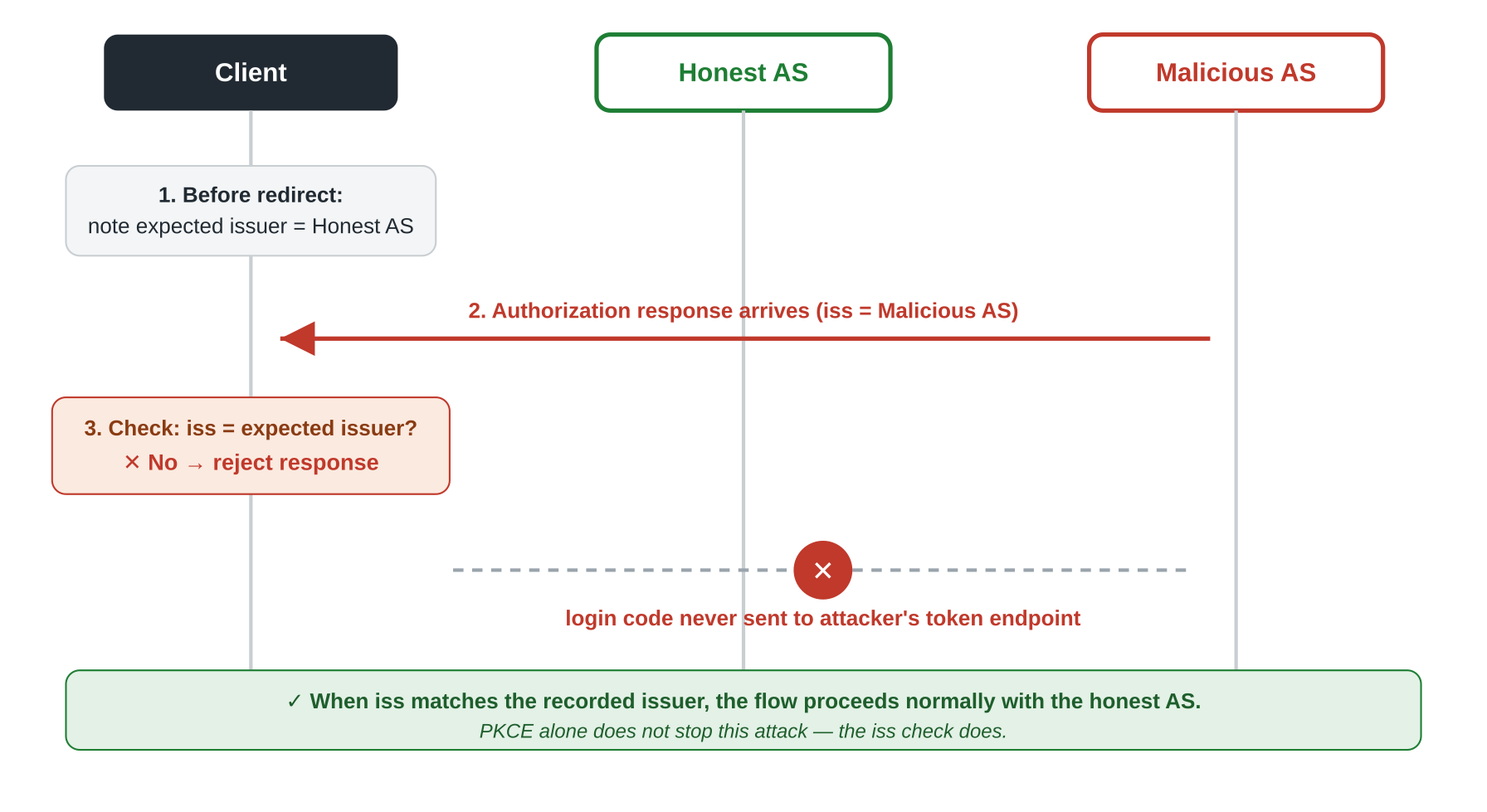
This is notable because PKCE, the protection most people assume covers this, does not stop mix-up attacks. The client sends its code verifier to whichever token endpoint it was tricked into using. (Read more on how PKCE is involved in MCP auth here: MCP Server Authentication in .NET.)
Today, authorization servers SHOULD emit iss - and must advertise it via authorization_response_iss_parameter_supported if they do. The spec signals that a future revision is expected to upgrade that to a MUST, so operators are encouraged to start emitting it now.
2. Credentials That Don’t Transfer Between Authorities
The change: Client credentials must be bound to the specific authorization server that issued them, keyed by its issuer identifier.
A gym membership card works just at your gym, not at every gym. If an MCP server changes which authorization server protects it (which can happen when a company migrates identity providers), the client must not keep flashing its old credentials at the new provider. It has to register afresh with the new authority.
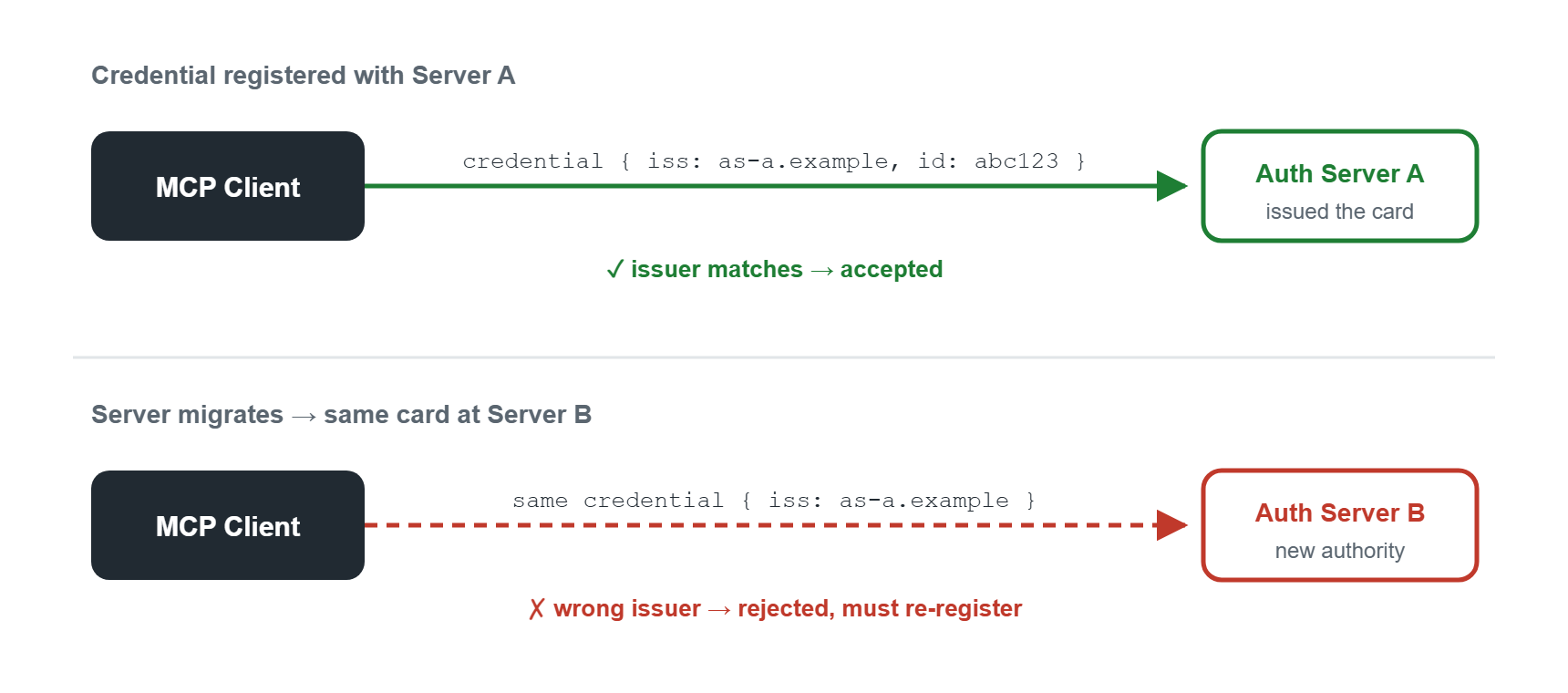
This applies to pre-registered credentials and those obtained via Dynamic Client Registration (DCR). Interestingly, it doesn’t apply to Client ID Metadata Documents (CIMD), which is MCP’s recommended registration mechanism, where the client ID is a self-hosted HTTPS URL that any authorization server can resolve on demand. CIMD identities are portable by construction, which quietly strengthens the case for using them.
3. Telling the Server What Kind of App You Are
The change: Clients must declare an OpenID Connect (OIDC) application_type when registering dynamically.
Apps can come in two flavors: web apps that live on a server somewhere, and “native” apps that run on localhost: desktop tools, mobile apps, CLIs. These two flavors receive login redirects differently. If a desktop app doesn’t mention the type, many identity providers assume “web” by default and then reject the app’s legitimate localhost redirect address. The result, until now, was a confusing registration failure. Declaring the type up front fixes this.
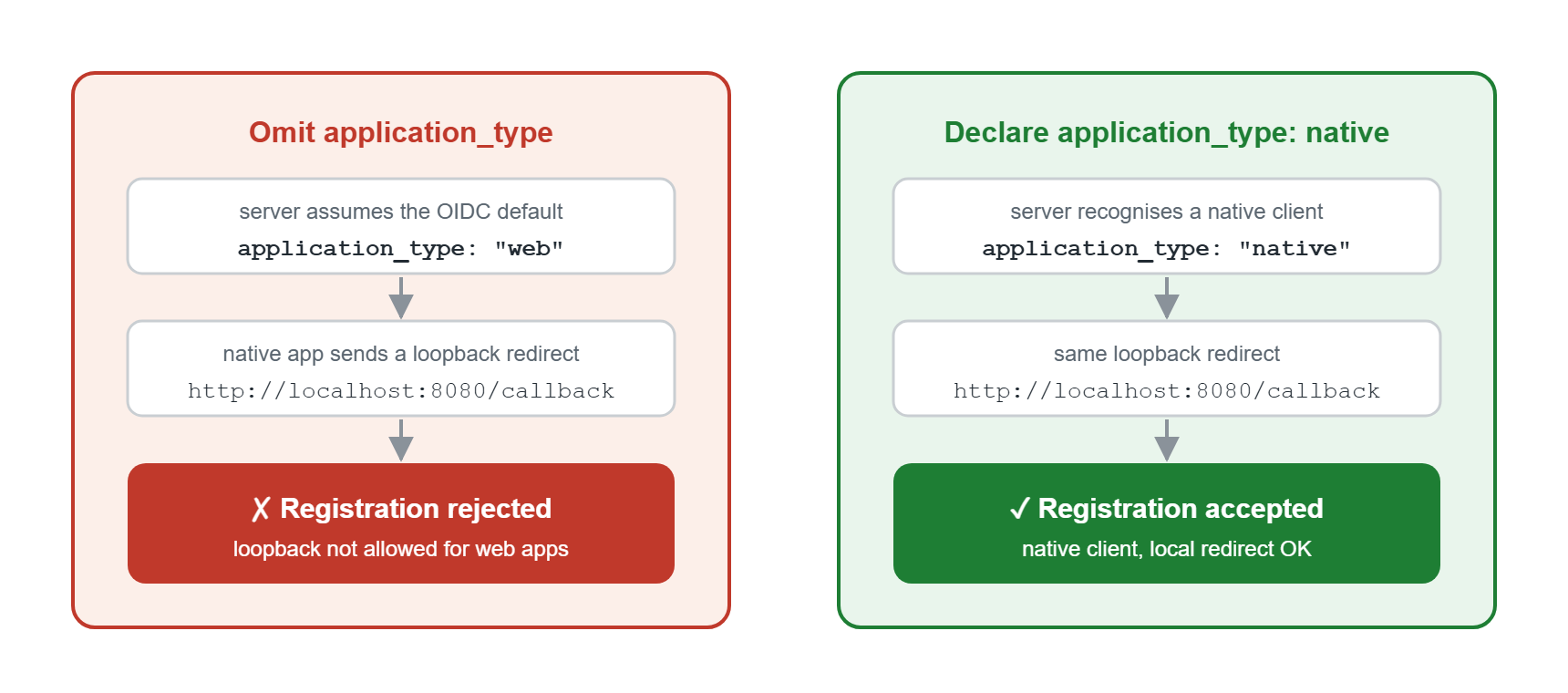
Omitting application_type defaults to "web" under OIDC Dynamic Client Registration, which conflicts with localhost redirect URIs. Native-style clients now register with application_type: "native". Servers that don’t implement OIDC can ignore the parameter, so the change is backward-compatible.
4. Clearer Rules for Token Refresh
The change: The spec now documents how to request refresh tokens from OIDC-style authorization servers.
A refresh token is what lets an app stay connected without asking you to log in every hour. Different identity providers handle this differently: some issue them automatically, others only provide them if you explicitly ask using an offline_access scope. Earlier MCP clients had no guidance on navigating this split, leading to inconsistent behavior.
Now clients should include refresh_token in their registered grant types, and they may add offline_access to the scope when the authorization server advertises it. The client must never assume a refresh token will always be issued. Resource servers shouldn’t advertise offline_access as a required scope, since staying signed in is a client concern, not a resource requirement.
5. Asking for More Scopes Without Losing What You Had
The change: The spec clarifies how scopes accumulate when a client needs to “step up” its access.
Imagine you have a library card that lets you borrow books, and one day you need access to the archive room. When you go back to the desk to ask, you’d want your new pass to cover both the archive and your existing borrowing rights, not swap one for the other.
The clarified rule: the server tells the client only what the current operation needs, and the client is responsible for combining that with everything it was already granted before re-requesting.
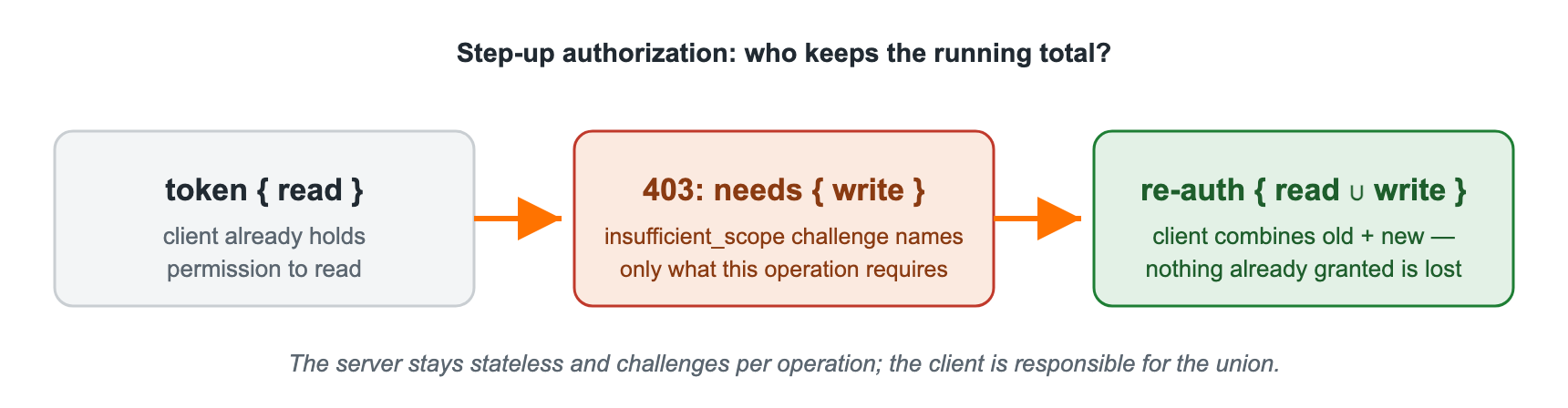
This keeps servers stateless. They emit per-operation insufficient_scope challenges without tracking each client’s history, while clients compute the union of previously requested and newly challenged scopes. Servers are also urged to emit all missing scopes for an operation in a single challenge rather than one at a time, so clients can re-request them all at once.
6. One Place to Look Up the Authorization Server
The change: The spec pins down exactly how clients discover an authorization server’s configuration.
Before the two systems can work together, one has to look up the other’s details: where to redirect logins, what options are supported. That lookup happens at the standardized “well-known” web addresses. But there were multiple conventions for constructing them, and ambiguity meant lookups could fail between perfectly good implementations. The spec now states the exact URL to use, and the order of precedence if multiple are present.
Now MCP uses the default oauth-authorization-server well-known suffix from RFC 8414 (there’s no MCP-specific suffix). It defines a priority order across OAuth and OIDC discovery endpoints for issuers with and without path components. There’s also a sharpened validation rule: the issuer value inside a fetched metadata document must exactly match the URL it was derived from, or the client must reject it.
Key Takeaways
When read together, the six changes tell one story: MCP’s authorization layer is being tuned to match how OAuth and OIDC are actually deployed. This can mean identity providers that default apps to “web”, servers that guard refresh tokens behind offline_access, or infrastructures that migrate authorization servers mid-flight. There are fewer grand redesigns, but more precise answers to questions raised in real deployments.
If you build MCP clients, the checklist is: validate iss, store credentials per issuer, declare your application_type, and combine your scopes on step-up. If you operate an authorization server, start emitting iss and advertising support for it now. The spec has signaled where things are headed, and you need to align with it.
Note: 2026-07-28 is a release candidate until its final publication date, so details may still shift. For the authoritative text, see the draft authorization specification and the accompanying changelog.
Conclusion
MCP’s authorization spec is settling into the work of matching real-world OAuth deployments, and that’s a good sign. If you’re building or securing an MCP integration, the checklist above should help you avoid the pitfalls and make your integrations more robust.